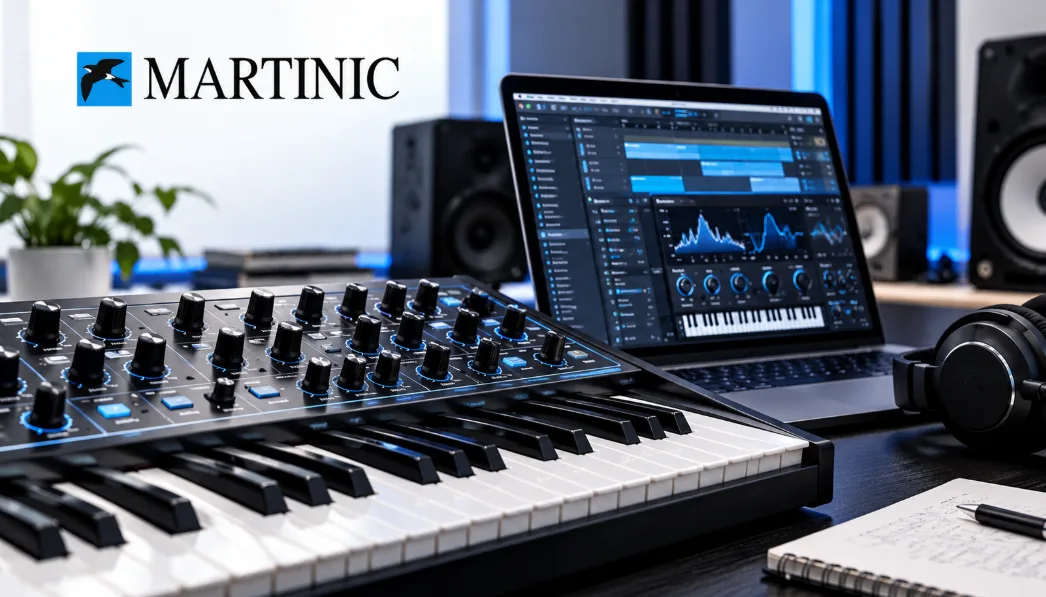
Synthesizers make sound design accessible to every producer, letting you build original basses, leads and pads directly inside your software studio.
Synthesizers have played an important role in electronic music for decades, but you no longer need a room full of hardware to experiment with synthesis.
Modern music-production software makes it possible to explore complex sounds directly inside a computer-based studio. For producers, this opens up a huge creative space for designing basses, leads, pads, textures, effects, and experimental sounds.
How Do You Get Started With Sound Design?
Begin with one software synthesizer and learn its core sections instead of jumping between many instruments.
- Oscillators: compare the 4 classic waveforms (sine, saw, square and triangle).
- Filters: sweep a low-pass filter to hear how brightness changes.
- Envelopes: adjust attack and release to turn a pluck into a pad.
- Practice: spend 15–20 minutes a session tweaking a preset to learn how it works.
Once these basics feel familiar, explore modulation with LFOs to add movement. Good sound design is mostly patient experimentation, so save the patches you like and revisit them later. Over time, you will start hearing how each control shapes a sound.
Related reading: Beyond Productivity: Software Tools for a Smarter Digital Lifestyle
Why Synthesis Matters
A synthesizer isn't simply another instrument. It can become a way of creating sounds that don't exist naturally.
A virtual synthesizer can give producers control over different elements of a sound, including its tone, movement, pitch, dynamics, and effects.
This makes synthesis particularly useful when you want something more specific than a standard piano, guitar, or sampled instrument can provide.
Start With the Basics
You don't need to understand every synthesis technique immediately.
Start with the basic building blocks: oscillators, filters, envelopes, and modulation. Experiment with one parameter at a time and listen carefully to how each change affects the sound.
This process can be much more valuable than simply downloading hundreds of presets.
Once you understand the fundamentals, creating your own sounds becomes considerably less intimidating.
Explore the Character of Analog-Inspired Sounds
Many producers are drawn to the warmth and character associated with classic hardware synthesizers.
Modern software can recreate many aspects of these instruments while providing the convenience of working entirely inside a DAW.
Experimenting with analog synth sounds can be a useful way to explore everything from deep basses and expressive leads to evolving pads and atmospheric textures.
The goal isn't necessarily to perfectly reproduce a particular vintage instrument. Instead, these sounds can serve as inspiration for creating something original.
Use Synthesis in Different Genres
Synthesizers aren't limited to one particular style of music.
Electronic producers may use them for almost every element of a track, while pop producers might use them for background textures, bass lines, or melodic hooks.
Film and game composers can also use synthesized sounds to create atmosphere and tension.
This versatility makes electronic music production an especially interesting area for anyone who wants to experiment with sound rather than relying entirely on traditional instruments.
Sound Design Is About Experimentation
There isn't always a correct way to design a sound.
Sometimes the most interesting results come from changing settings without knowing exactly what will happen. You might start with a simple patch and end up with something completely different.
Sound design software makes this experimentation accessible because you can save versions, automate parameters, compare sounds, and quickly return to earlier ideas.
Try changing one element at a time and save interesting results. Over time, you can develop your own collection of sounds and techniques.
Integrate Synths Into Your DAW
Once you've created or selected a sound, the next step is integrating it into the larger production.
VST instruments can be loaded into compatible digital audio workstations, allowing synthesizers and other virtual instruments to become part of a complete production.
From there, you can sequence melodies, automate parameters, add effects, layer multiple sounds, and mix everything together.
Build a Personal Sound Library
As you experiment, save the sounds that genuinely inspire you.
Over time, your library can become a reflection of your own production style. Instead of searching endlessly for the perfect preset every time you start a track, you'll have a collection of sounds you already understand and enjoy working with.
MARTINIC can be explored by producers looking to add software instruments and music-production tools to their digital setup.
Frequently Asked Questions
What is sound design?
Sound design is the process of creating and shaping sounds, often with synthesizers, effects and sampling, to give music a unique character.
Are software synthesizers as good as hardware?
Many software synths offer excellent sound and flexibility at a lower cost, and they are easier to recall and automate in a project.
How can I learn synthesis faster?
Start from presets, change one parameter at a time and listen closely to how each change affects the sound.
Final Thoughts
Ultimately, sound design isn't about owning the largest collection of synthesizers. It's about learning how to shape sound and using that knowledge to turn musical ideas into something distinctive.