The simplest way to handle transportation from the airport is to decide before you fly. Check which options actually serve your arrival airport, match them to your landing time, luggage and group size, and pre-book only when certainty matters more than flexibility. Twenty minutes of research at home beats making rushed decisions in the arrivals hall after a long flight.
This guide compares the main ways to get from the airport to your accommodation, gives you a step-by-step planning method, and lists the mistakes that most often turn a simple arrival into a long, expensive one. For the bigger picture beyond arrival day, see Getting Around on Vacation: How to Choose the Right Transportation for Your Trip.
What Are Your Options for Transportation From the Airport?
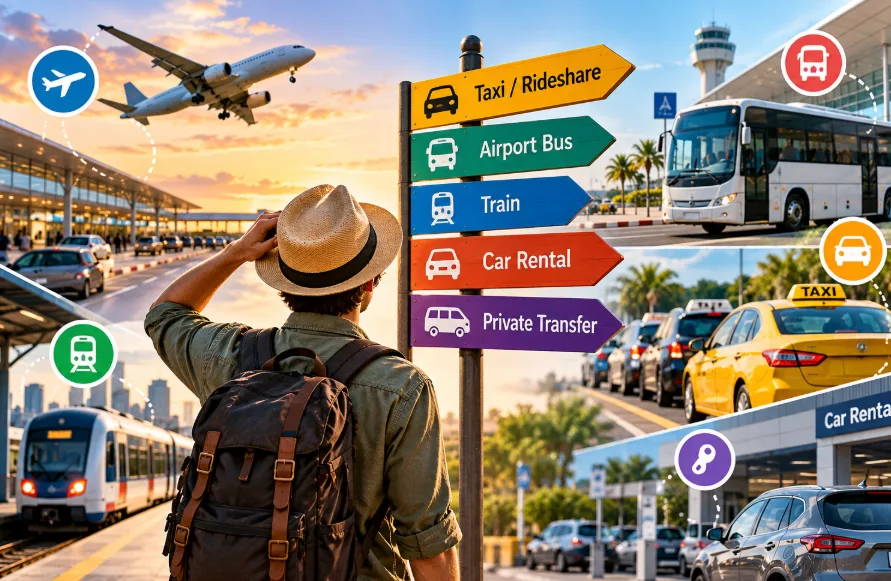
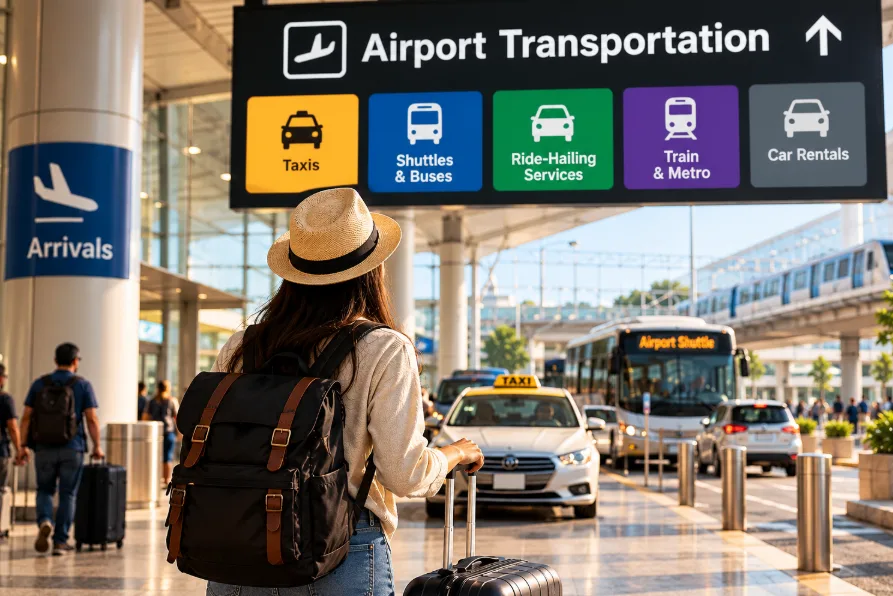
Most airports offer some mix of the six options below. Not every airport has all of them, so your first job is to find out which ones exist where you land.
Train, metro or airport express
- Pros: Fast and predictable, because trains avoid road traffic. Good value for solo travellers and couples.
- Cons: Stations can mean stairs, long corridors and crowded platforms. Services may stop late at night. You usually still need a second leg from the city station to your hotel.
- Best for: Light packers arriving in the daytime whose accommodation is near a station.
- Skip it if: You have several large suitcases and at least one change of line.
Airport bus or coach
- Pros: Typically one of the cheapest options. Luggage goes in a hold underneath, and some routes stop near major hotels.
- Cons: Slower in traffic, with fixed stops that may be nowhere near your hotel. Timetables thin out in the evening.
- Best for: Budget travellers with time to spare, and airports without a rail link.
- Skip it if: You land at rush hour in a city known for congestion and have a dinner booking.
Shared shuttle
- Pros: Door-to-door at a lower price than a private car. Useful when public transport does not reach your area.
- Cons: You wait for other passengers and may ride along while others are dropped first. Total travel time is hard to predict.
- Best for: Solo travellers or couples who want hotel drop-off without paying for a whole vehicle.
- Skip it if: You are on a tight schedule or travelling with tired young children.
Taxi or ride-hailing app
- Pros: No booking needed, straight to your door, available most hours at larger airports.
- Cons: Prices change with traffic, time of day and demand. Queues build when several flights land together. Unofficial drivers approaching you inside the terminal are a known risk in many cities.
- Best for: Small groups splitting the fare, or anyone arriving after public transport has stopped.
- Skip it if: You have no working data or local payment method and the airport has no official rank with posted fares.
Pre-booked private transfer
- Pros: Price agreed in advance, a driver waiting for you, room for luggage, and child seats on request with many operators. Nothing to decide on arrival.
- Cons: Usually the most expensive choice for one person. Less forgiving if your flight is badly delayed and the operator's waiting policy is strict.
- Best for: Families, groups, late-night arrivals, travellers with mobility needs, and first-time visitors who do not speak the local language.
- Skip it if: You travel solo and light, and a frequent train runs to your door.
Rental car
- Pros: Makes sense if you are heading somewhere rural or will drive for most of the trip.
- Cons: Driving tired on unfamiliar roads, sometimes on the other side, is a real safety concern. City parking is often expensive and scarce.
- Best for: Travellers going straight to the countryside, ideally after a short daytime flight.
- Skip it if: Your first few nights are in a city centre. Pick the car up later instead.
Which Option Fits Your Arrival?
Price matters, but four other factors usually decide the right choice.
Arrival time. A mid-afternoon landing gives you every option. Landing after about 10 pm or before 6 am can rule out trains and buses entirely, leaving a taxi queue as the only fallback. If you land outside normal hours, sort out your airport transportation before you leave rather than at midnight in the terminal.
Luggage. With one backpack you can take almost anything. Two large suitcases per person, a pushchair, golf clubs or a surfboard change the picture. A cheap route with two train changes and station stairs stops being cheap in effort.
Group size. Public transport is priced per person; taxis and private transfers are priced per vehicle. For three or four people, a car can cost about the same as individual train tickets and is far more comfortable.
The last stretch. A train to the city centre is only half the answer if your hotel is a 25-minute walk or another bus ride from the station. Always map the route door to door.
Some realistic examples:
- Solo traveller, carry-on only, landing at 2 pm: the train or express bus is almost always the sensible pick.
- Couple landing at 11:30 pm: check the last train. If the margin is under an hour after landing, use the official taxi rank or pre-book a transfer.
- Family of four with car seats and five suitcases: a pre-booked private transfer, with child seats requested in writing.
- Group of friends heading to a beach town 90 minutes away: a shared shuttle or private van usually beats piecing together buses.
How Do You Plan Your Airport Transfer, Step by Step?
Work through these steps one to two weeks before you leave. That is early enough to book if needed, and late enough that your plans are settled.
1. Check the airport's official website. Find the ground transport page. It lists rail links, bus routes, official taxi ranks and operating hours, and it is more reliable than forum posts.
2. Note your landing time and add a buffer. Allow roughly 30–60 minutes for passport control and baggage on international flights, more at large hubs or peak times.
3. List the options running at that hour. Cross out anything that stops before you will reach the exit.
4. Map the full route to your accommodation. Include the walk or second ride from the drop-off point. Use street view to spot steep hills or steps if your bags are heavy.
5. Compare total cost for the whole group. Multiply per-person fares by the number of travellers before comparing with per-vehicle prices.
6. Decide whether to pre-book. The next section covers when it is worth it.
7. Save everything offline. Download offline maps, screenshot your confirmation, and write your accommodation address in the local language and script.
8. Sort payment. Check whether ticket machines and taxis accept foreign cards. Carry a small amount of local currency as a fallback.
9. Prepare a backup. Know where the official taxi rank is and when the last public transport leaves, in case plan A falls through.
Our separate guide on how to plan your airport transportation for a stress-free arrival goes deeper into cost, luggage space and timing for each option.
Should You Pre-Book or Buy on Arrival?
You do not need to book everything ahead. In many cities, buying a train ticket at a machine after landing takes a couple of minutes, and booking in advance adds nothing.
Pre-booking is worth it when:
- You land late at night or very early in the morning.
- You travel with children, older relatives or a lot of luggage.
- You do not speak the local language and want the price fixed beforehand.
- You arrive during a major holiday or event, when taxi queues and prices rise.
- The airport has a reputation for touts or confusing transport.
Buying on arrival is fine when:
- A frequent train or bus leaves from the terminal during your arrival hours.
- You travel light and your plans may change.
- You want to keep the option of switching to a taxi if you are exhausted.
Booking platforms let you compare airport transfer options side by side, including private cars, shared shuttles and sometimes rail passes. kkday is one such platform, with a particularly wide range across Asia. Its strengths are a price shown upfront and a confirmation you can show the driver. Its limits are those of any third-party booking: a local operator delivers the service, so read recent reviews, check the cancellation and delay policy, and confirm the exact meeting point. For a simple rail link, buying from the operator or at the station is just as easy.
What Should You Ask Before Booking a Transfer?
Whichever company or platform you use, get clear answers to these questions before you pay:
- Do you track flights? If not, a delay can leave you without a driver.
- How long will the driver wait after landing? Free waiting time varies widely between operators.
- Where exactly is the meeting point? Inside arrivals with a name sign, at a specific door, or in a car park?
- What happens if my flight is cancelled or diverted? Ask about refunds and rebooking.
- Is the price per vehicle or per person, and what does it include? Check tolls, night surcharges, extra bags and tips.
- What size is the vehicle? A "car for four" may fit four people but not four large suitcases.
- Can you provide child seats, and are they the right type? Ask for confirmation in writing.
- Who do I contact if no one is there? Get a phone or messaging number that works at your arrival time.
Who Pre-Booked Transfers Suit, and Who Should Skip Them
They suit:
- Families with young children, especially if you need child seats.
- Groups of three or more, where the per-person cost becomes reasonable.
- Late-night and very early arrivals.
- Travellers with mobility issues or bulky equipment.
- First-time visitors facing a language barrier or a city known for taxi scams.
You can probably skip them if:
- You are a solo traveller or couple with light bags landing in daylight.
- A direct, frequent train runs to a station near your accommodation.
- You are on a tight budget and comfortable with public transport abroad.
- Your route is prone to long delays and the operator has a strict waiting policy.
If you are unsure which camp you fall into, How to Choose the Best Transportation for Your Travel Style helps you weigh comfort against cost and flexibility.
Common Mistakes to Avoid
Assuming you will walk straight out. Immigration queues and slow baggage belts regularly add an hour. Do not book a pickup for your exact landing time unless the operator tracks flights.
Ignoring the last train. Many airport rail links stop around midnight or earlier. Check the timetable for your actual arrival day, as weekend and holiday schedules differ.
Accepting rides from people who approach you in the terminal. Use official ranks, app-based services or your pre-booked driver at the agreed meeting point.
Forgetting the final leg. The central station is not your hotel. Plan the last kilometre too.
Comparing per-person prices with per-car prices. A transfer that looks expensive is often the cheapest choice for a family once you add up the tickets.
Relying on mobile data. Your phone may not connect straight away. Keep offline maps, screenshots and a written address ready.
Skipping the small print. Know how long the driver waits and what happens if your flight is cancelled or diverted.
Your Arrival-Day Checklist
Run through this the day before you fly:
- Booking confirmation saved offline and, ideally, printed.
- Driver's or operator's contact number and the exact meeting point.
- Accommodation address in the local language, plus the host's phone number.
- Offline map of the area downloaded.
- Last train or bus time noted, in case plans change.
- Location of the official taxi rank as a backup.
- A card that works abroad and a small amount of local cash.
- Phone charged, with a power bank in your hand luggage.
- Your flight number shared with the transfer company, if you booked one.
If your flight runs late, message your driver as soon as you land, even if they track flights. One short message prevents most misunderstandings.
Frequently Asked Questions
Should I book airport transfers in advance?
Book ahead if you arrive late at night, travel with children or lots of luggage, or do not speak the local language. For daytime arrivals at airports with frequent trains, buying a ticket on arrival is usually fine. The deciding question is how much you value certainty over flexibility.
What is the cheapest way to get from the airport?
Public buses and trains are usually the cheapest for one or two people. For groups of three or more, a taxi or private transfer can work out similar per person once you add up individual fares. Always compare the total for your whole group, including the last leg to your accommodation.
How long should I allow between landing and my transfer pickup?
As a rule of thumb, allow 30–60 minutes for international arrivals and less for domestic flights with hand luggage only. At large hubs or at peak times, allow more. If your operator tracks flights, give them your flight number and let them adjust.
Are ride-hailing apps a good option at airports?
They work well at many airports and show the price before you ride. Some airports require app pickups from a specific zone, which can be a long walk from arrivals, so check the signs. Make sure the app works in that country and that you will have data on landing.
What if my driver is not there?
Check the meeting point details first, then call or message the operator using the contact in your confirmation. Give it a reasonable wait before switching to your backup, and keep proof of the no-show if you plan to ask for a refund.
Final Thoughts
Good airport planning comes down to a few honest questions: when you land, how much you carry, how many of you there are, and how far your bed is from the drop-off point. Answer those at home, pick one main option and one backup, and save the details offline. Book ahead when certainty matters; buy on arrival when a simple train will do. Once you have arrived, our guide to choosing the right transportation for your whole holiday helps you plan the rest of the trip.