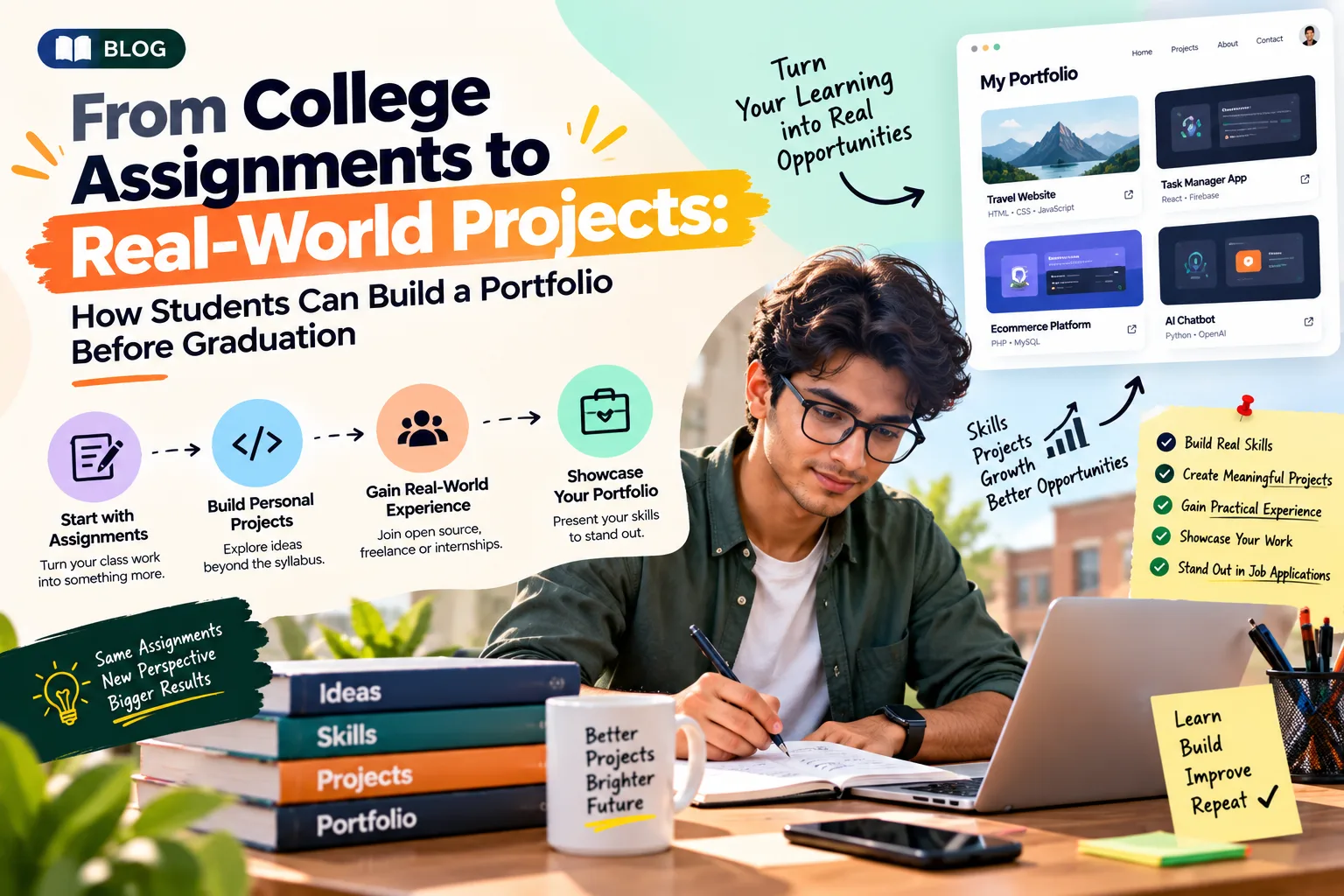
The easiest way to build a portfolio before graduation is to start with the assignments you already complete and add a few real-world projects that show how you apply your skills.
College students spend years completing essays, presentations, research papers, lab work, group assignments, and exams. These experiences are an important part of education, but there is another question worth asking:
What will you be able to show someone when you graduate?
A degree can demonstrate what you studied. A resume can explain where you worked or interned. But a collection of actual projects can show how you apply what you've learned.
That's why building a student portfolio before graduation can be a valuable part of the college experience.
How Can Students Build a Portfolio Before Graduation?
You don't need a finished career to build a portfolio. A small, well-chosen collection of work often says more than a long list of courses.
- Choose your 3–5 strongest assignments or projects.
- Add at least 1 real-world project, such as freelance, volunteer or club work.
- Write a short summary of 2–3 sentences explaining the goal, your role and the result.
- Host it online so you can share a single link.
- Review and update it every semester.
Related reading: Beyond the Classroom: 5 Skills College Students Should Build Before Graduation
Start With What You're Already Learning
You don't necessarily need to start from scratch.
Look at your current coursework and identify assignments that could be developed into something more practical.
A marketing student could turn a class assignment into a complete campaign proposal. A computer science student could develop a small application. A business student might create a market analysis or financial model. A design student could turn coursework into a polished case study.
The objective isn't to make every college assignment look impressive.
Instead, look for opportunities to turn academic knowledge into something that demonstrates how you think, solve problems, and communicate your ideas.
Turn Assignments Into Projects
There is a significant difference between submitting an assignment and developing a project.
An assignment usually has one primary purpose: demonstrate that you understand the material.
A project can go one step further.
You can define a problem, research possible solutions, make decisions, create something, evaluate the outcome, and document what you learned.
This is where project-based learning becomes particularly useful.
For example, instead of simply writing about social media marketing, you could create a hypothetical campaign for a real brand. Rather than writing about data visualization, you could find a public dataset and build a dashboard around it.
The project doesn't have to be connected to a real employer to demonstrate your ability to apply knowledge.
Build Things People Can Actually See
A portfolio becomes more useful when another person can understand what you created without needing a long explanation.
Depending on your field, this could include:
- A marketing campaign
- A website
- A research project
- A data dashboard
- A financial model
- A UX case study
- A presentation
- A business plan
- A programming project
- A written analysis
You don't need dozens of projects.
Three to five well-documented projects can give you a starting point, particularly when each one demonstrates a different ability.
Use Online Learning to Fill Skill Gaps
Sometimes your college curriculum doesn't cover every skill you need for a particular project.
That's where additional learning can help.
Coursera offers courses and learning programs across areas including business, computer science, data science, marketing, IT, and personal development. Its catalog also includes hands-on projects and Professional Certificates designed around specific skills and career paths.
Instead of taking courses simply to collect certificates, start with a project idea.
Ask yourself:
“What do I want to build, and what do I need to learn to build it?”
Then use career-focused courses to close those specific knowledge gaps.
This approach can make additional learning much more purposeful.
Don't Underestimate Hands-On Experience
Watching lectures and reading course material can introduce you to a subject. Applying the knowledge is where you begin to understand how it works in practice.
For example, a student learning data analytics could work with a public dataset and answer a real question.
Someone studying digital marketing could create a complete campaign strategy, including audience research, creative concepts, channel selection, and measurement.
A student interested in UX could redesign the experience of an existing website and document the research and reasoning behind the changes.
These hands-on projects can demonstrate skills that are difficult to communicate through a list of course titles alone.
Coursera's current higher-education offerings also emphasize applied learning and projects that help students demonstrate real-world capabilities.
Document the Process, Not Just the Final Result
One common mistake is showing only the finished product.
Your process can be just as interesting.
For every project, consider documenting:
The problem: What were you trying to solve?
The approach: How did you decide what to do?
The tools: What software, methods, or frameworks did you use?
The challenges: What didn't work initially?
The outcome: What did you create or discover?
The learning: What would you do differently next time?
This turns a simple project into a story about your problem-solving ability.
Connect Projects to the Career You Want
Your portfolio doesn't have to represent everything you've ever studied.
It should gradually reflect the direction you're interested in pursuing.
If you're considering data analysis, prioritize projects involving spreadsheets, SQL, visualization, or statistics.
If you're interested in marketing, create projects around market research, advertising, content, analytics, or customer behavior.
If technology interests you, build projects that demonstrate the languages, tools, or platforms relevant to the roles you're exploring.
This is where building job-ready skills becomes more meaningful: you're not learning randomly; you're developing capabilities that connect to a specific type of work.
Coursera's Campus Skills research similarly looks at the relationship between the skills students develop and the jobs they're interested in, including roles such as data analyst, marketing specialist, software engineer, and machine learning engineer.
Make Your Portfolio Easy to Understand
You don't need an expensive website to start.
A simple online portfolio can include:
- A short introduction
- Your education and areas of interest
- Three to five projects
- A short explanation of each project
- The tools and skills used
- Links to relevant work
- Your contact information
Keep the design simple.
The person viewing your portfolio should be able to understand within a few minutes what you are interested in and what you can actually do.
Use College as Your Testing Ground
One of the biggest advantages of being a student is that you have room to experiment.
You can try a subject and discover that you don't enjoy it. You can build something that doesn't work. You can change your direction.
That's part of the process.
You don't need to know exactly what your career will look like before graduation. Instead, use college to test different possibilities through coursework, internships, extracurricular activities, online learning, and independent projects.
Each experiment can teach you something about both your abilities and your interests.
Frequently Asked Questions
What should a student portfolio include?
Include your best coursework, personal or real-world projects, and short explanations of what you did and why it matters.
Do I need a website for my portfolio?
Not necessarily, but a simple online page makes it easy to share with employers. A well-organised PDF can also work.
How many projects should a portfolio have?
Quality matters more than quantity. Three to five strong examples are usually enough to start.
Final Thoughts
A college education doesn't have to end with a degree and a resume.
The projects you create along the way can become evidence of how you apply what you've learned.
Start small. Take an interesting assignment and develop it further. Identify a skill you want to improve and create something that requires you to use it. Document your process and gradually build a body of work that represents the direction you want to pursue.
By the time graduation arrives, you'll have more than a list of subjects you studied.
You'll have examples of what you can actually do.